
Wurlitzer Organ

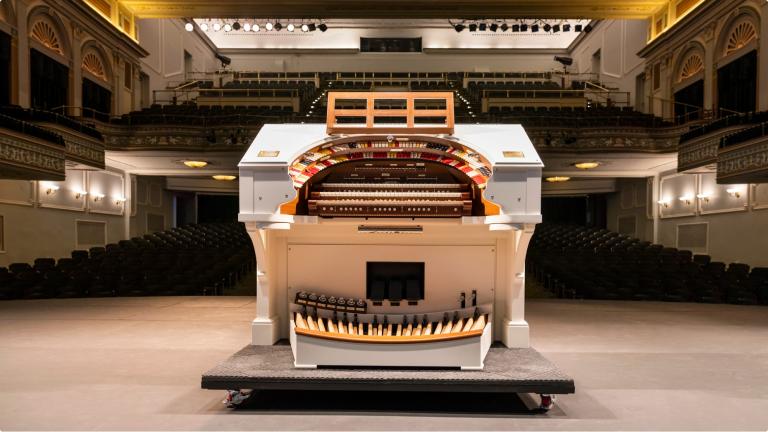

the Lucas Theatre for the Arts celebrated the restoration of its original Mighty Wurlitzer pipe organ. Installed in 1925 and removed from the theater in the 1970s, the fully restored organ was returned to the theater in 2023 following a meticulous, years-long process. Of the 2,143 Wurlitzer pipe organs produced by the Wurlitzer Company between 1910 and 1943, fewer than 15 remain in the building where they were originally installed.
The Golden Age of organs
In the 1920s, nearly every movie palace had a pipe organ to accompany silent films. After the Lucas Theatre first opened in 1921, its original Pilcher pipe organ was quickly deemed unsatisfactory for the theater’s needs. During the heyday of the theater pipe organ and the movie palace, the Wurlitzer Company was renowned for installing the finest instruments of the era. Dubbed “The Unit Orchestra,” the organ had pipe voices that mimicked strings, clarinets, trumpets, and flutes, a full orchestra of sounds — including xylophone, marimba, drums, and cymbals — as well as unique percussion sound effects that were utilized when accompanying silent films, such as thunder, bird whistles, train whistles, automobile horns, and horses’ hooves.
An investment in sound
At an expense of $60,000 (over $1 million in 2023 dollars), the Lucas Theatre’s Wurlitzer organ was installed with a three-keyboard console, 11 ranks (speaking voices of pipes), plus full percussion. The 1925 Wurlitzer holds the serial number Opus 1180. At the time of its installation, it was declared by Savannah press to be the “finest, most modern, and most complete theater organ in the South.” The reinstalled instrument has seven additional sets of pipes for a far grander scope of sound, featuring over 1,620 pipes in total. With the arrival of the “talkies” in the 1930s, many theater organs fell silent, but the Lucas Theatre’s organ continued to be used through the early 1940s. A typical show would start with a newsreel. Next a comedy short subject or cartoon was shown. A preview of coming attractions was run and then the organ would be played. After the Wurlitzer it was time for the main attraction — the feature film.
Saved from destruction
In the 1970s, when it was feared the theater would be torn down, the organ was purchased and removed by Dr. Ed Simmons. It later came into the hands of the Atlanta Chapter of the American Theatre Organ Society, who assisted in its care and moving it from Atlanta back to Savannah. For years, the Lucas Theatre’s chambers remained empty and the organ sat in a warehouse.
Restored to glory
As part of SCAD’s ongoing commitment to historic preservation across its university locations, including its 100-year commemoration of the Lucas Theatre for the Arts, the organ has been reinstalled and restored to its full glory. Very few pipe organs worldwide have been removed over the years from their original homes, only to return later. Under the expertise of the Atlanta Chapter of the American Theatre Organ Society (ATOS) and the A.E. Schlueter Pipe Organ Company, the Lucas Theatre Wurlitzer has surpassed its former glory. Surviving decades of idling in pieces and a fire prior to its complete restoration, the Mighty Wurlitzer is ready to amaze audiences in the 21st century.
The Mighty Wurlitzer restoration marks a rare and remarkable homecoming for these magnificent instruments. Unlike its church or concert hall counterparts, a Wurlitzer theatre organ can present pops, Broadway, swing and jazz, the best of ballads, and everything in between — and is the perfect instrument for the reintroduction of silent film classics at the Lucas Theatre for the Arts.